
WordCruncher is a software developed right here in ODH that allows you to analyze texts like the Scriptures, General Conference, the poems of Emily Dickinson, and more! If you’ve never done text analysis before, you may be unsure about where to start, but I hope that this article sparks some ideas. Once you’ve got a research question, WordCruncher can help you answer almost anything about your text.
Analyzing the Words of President Russell M. Nelson
General Conference Addresses is our second-most installed collection, after The Scriptures. Given that we just recently had a General Conference, we will take a closer look at President Nelson’s key words and phrases through WordCruncher’s Phrase Compare Report (which happens to be my favorite WordCruncher report).
President Russell M. Nelson led the Church of Jesus Christ of Latter-day Saints from 2018 until his recent passing last September. His leadership was exemplary and his vocabulary was influential. For example, he coined the phrase think celestial in October 2023, which was referenced many other times by other speakers in following conferences.
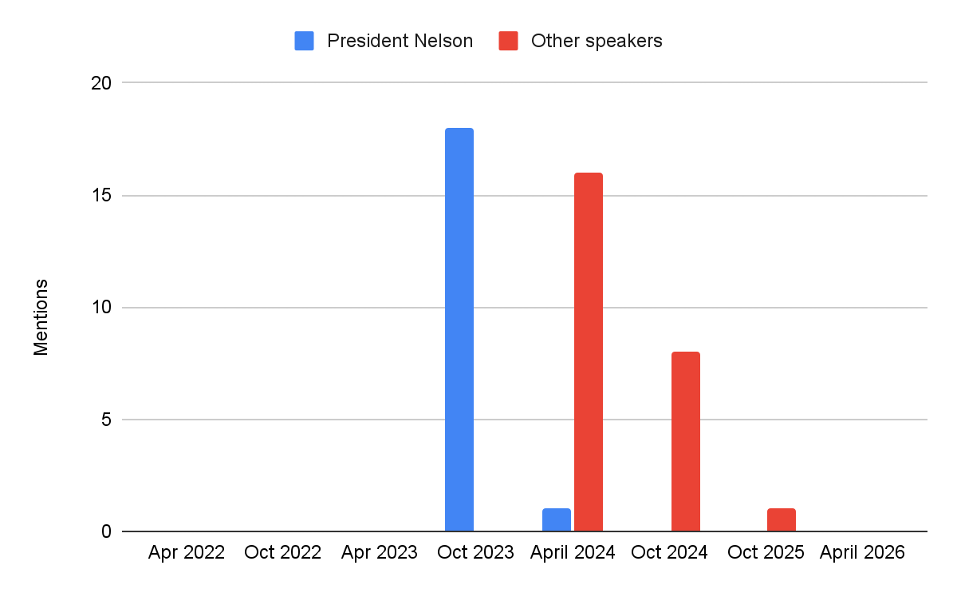
Figure 1. Occurrences for the exact phrase think celestial in General Conference Addresses. Data exported from WordCruncher’s Frequency Distribution report.
For those familiar with the phrase think celestial, this isn’t a particularly novel finding, but it is a good example of a key phrase (and one that sparked usage in other speakers, as shown in Figure 1). To find other key phrases that President Nelson used over the years, we can run the Phrase Compare report.
The Phrase Compare Report allows you to identify key words and phrases in a text. For the purposes of our research here, our text will comprise talks by President Nelson. President Nelson was first called in April 1984, but for the analysis today we will focus on his more recent talks–those given from 2008 to his last talk in 2025. We’ll use the General Conference Address (2008-2026) collection and limit the text to talks by President Nelson with attribute bounds.
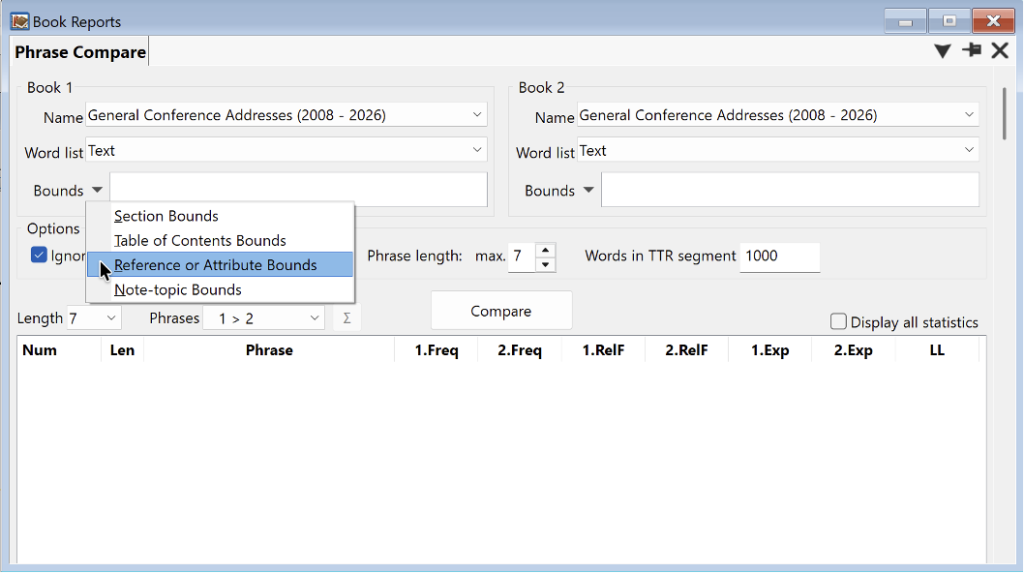
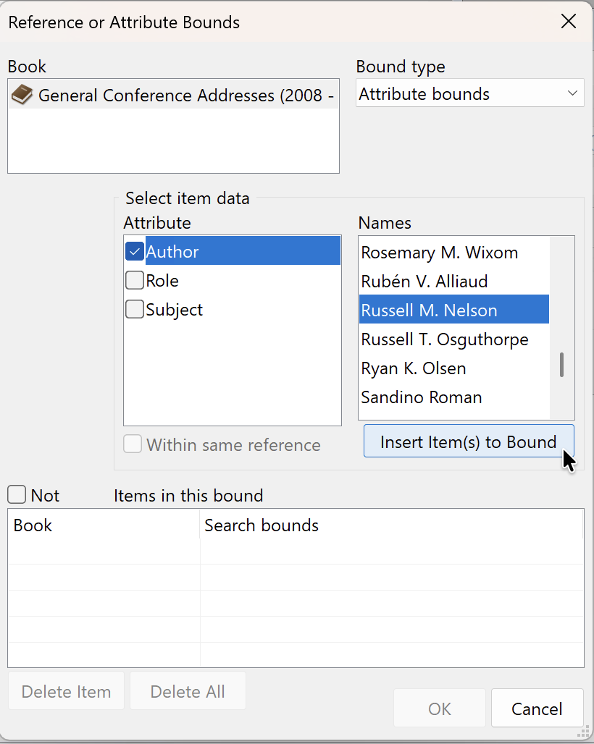
Figure 2. Limiting our Phrase Compare analysis to talks given by Russell M. Nelson.
When you calculate the report, the results you get are dependent on the comparison that you choose:
1. Compare within one text
This calculates the most common words and phrases in a text. In an English text, you’ll see a lot of results for words like the and a (in linguistics, these are referred to as “stop words”), and if you scroll down far enough you will start to see content words.
2. Compare the text to another text
This compares words and phrases in each text, finding phrases that are 1) unique to one text, 2) occur more frequently in one text than another, and 3) occur evenly in both.
Because method #2 involves a comparison to a reference text, I find this method to be especially interesting. It identifies themes and content words, rather than just finding the most frequent words and phrases.
Method #1: Compare within one text (Default)
In a General Conference, there are some phrases that nearly everyone says. These phrases aren’t necessarily important to the content or themes of the talk, but can serve important functions in the structure of the talk (e.g., in the name of Jesus Christ, amen) or in the language of the Church (e.g., referring to the Church’s full name). This comparison will identify those words and phrases.
You can change the length of the report to view the most frequent words and phrases in the text. Method #1 finds words like the and of, which are frequent words that President Nelson uses, but they don’t really tell us anything about thematic or linguistic patterns in his talks.
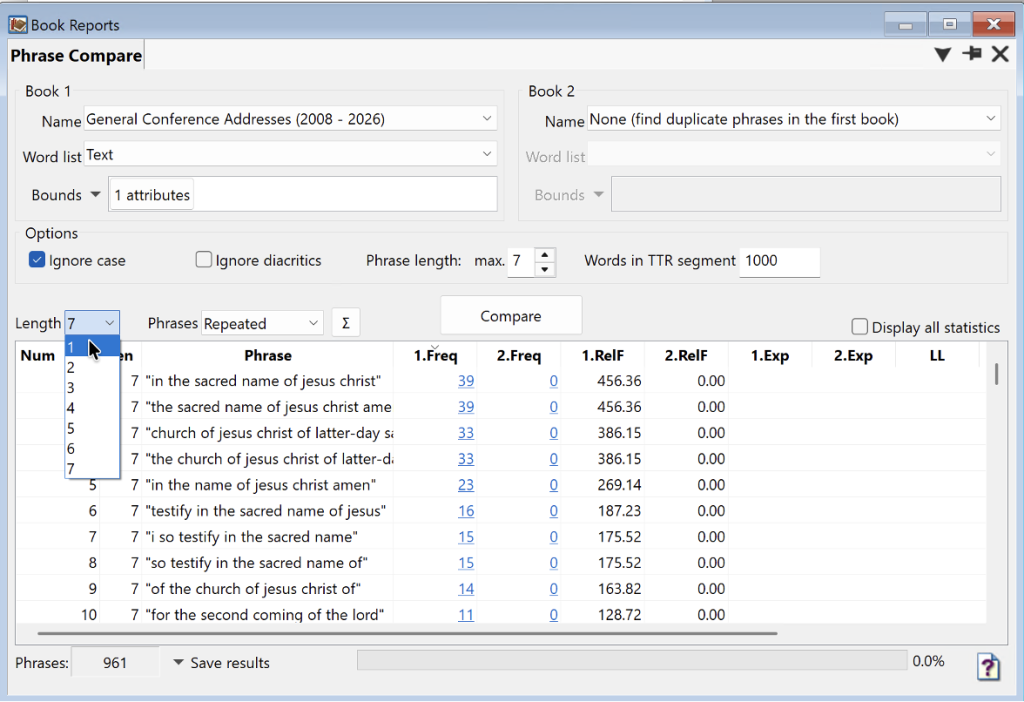
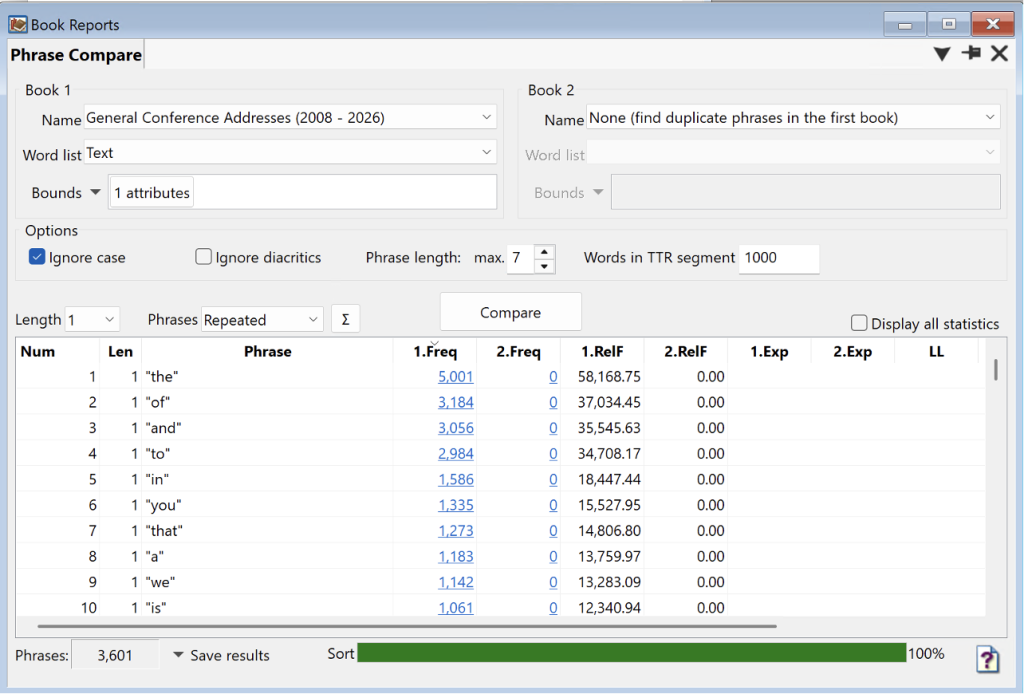
Figure 3. Change phrase length.
Method #2: Compare to another text
If we want to focus on what makes President Nelson’s Conference addresses unique, the best comparison would be to compare against other speakers in General Conference. To do this, we will select our second text: talks given by everyone but President Nelson.
Just add an attribute bound that looks the same as the first, but make sure to check the Not box.
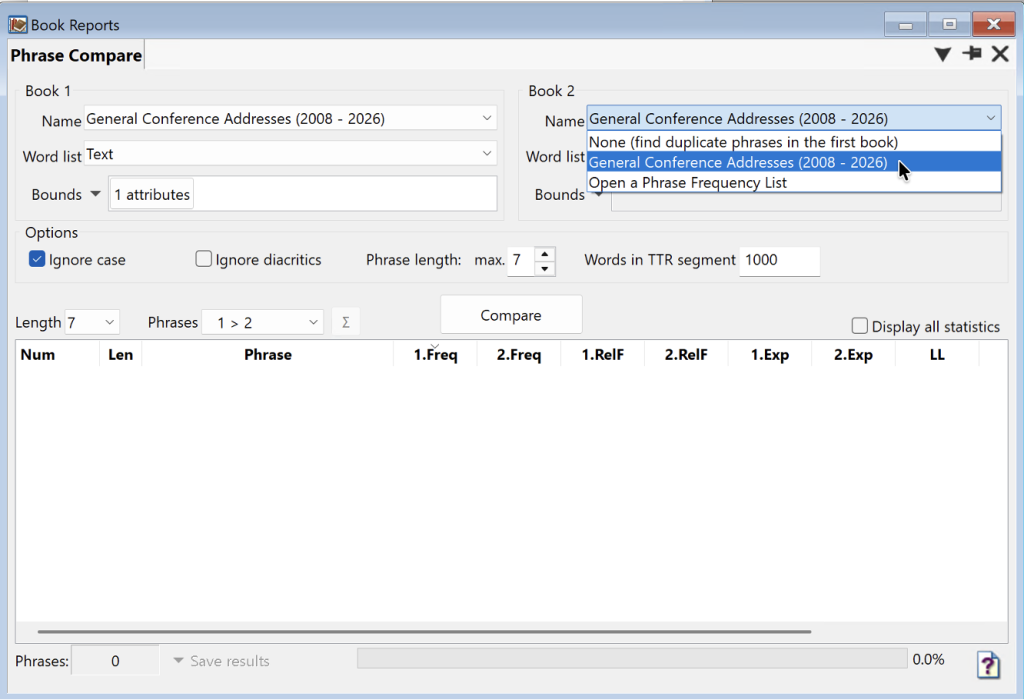
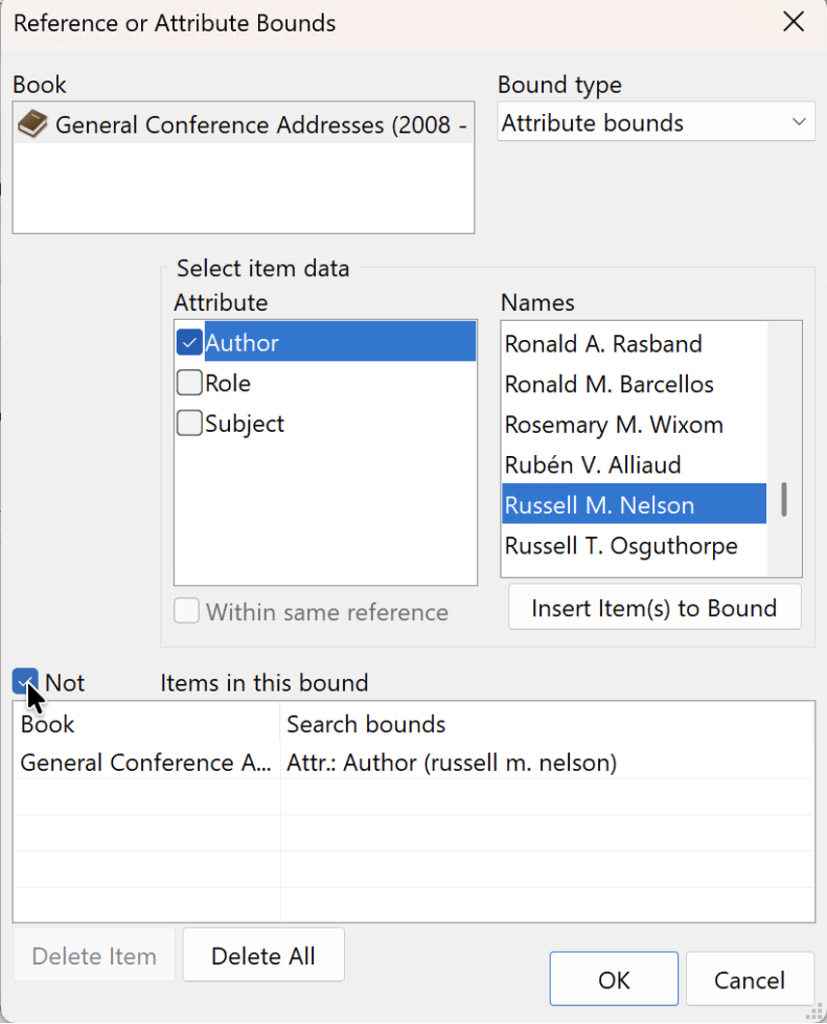
Figure 4. Compare “Book 1” (talks by Russell M. Nelson) to “Book 2” (talks by all speakers except Russell M. Nelson) using attribute bounds.
Once the report has finished the comparison, I like to start by looking at the key words (1-grams):
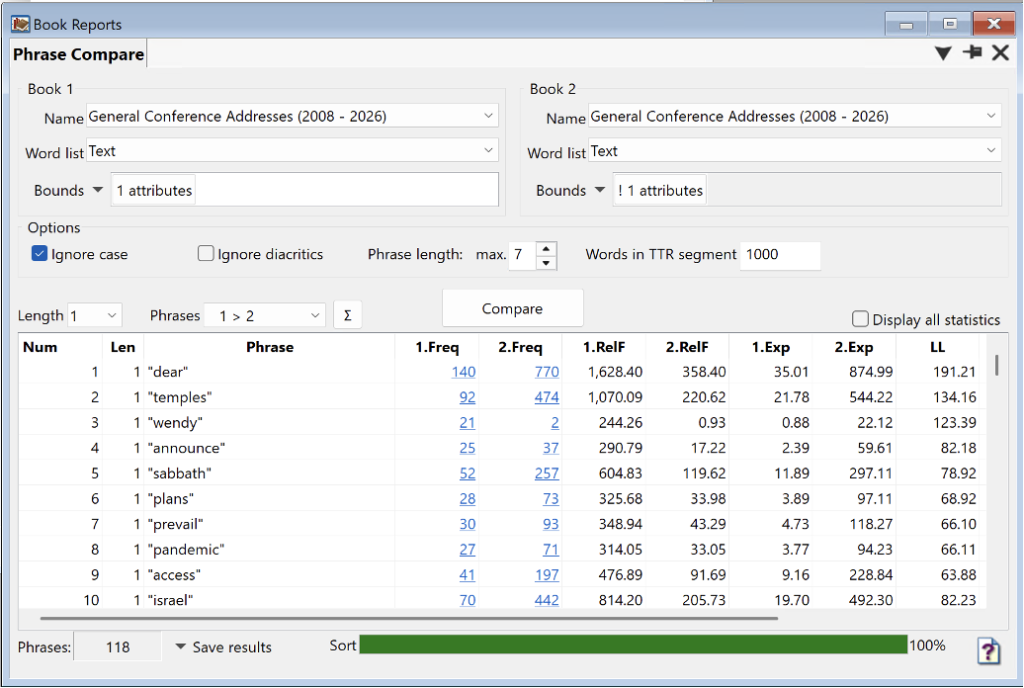
Figure 5. One-word phrases that occur more in Russell M. Nelson’s talks than in other speakers’ talks.
Each of these words can tell us a story about President Nelson’s language and what is different from other General Conference speakers. Wendy, for example, is his wife, so we would expect him to mention her name more frequently than other speakers would. He often announced plans to build new temples, so I’m not surprised to see those words show up in the top ten. What may be more surprising are the words sabbath and access.
Sabbath
President Nelson used the word sabbath 52 times between 2008 and 2025. To take a closer look, double-click on the frequency for sabbath (52). This will automatically show the search results for the word.
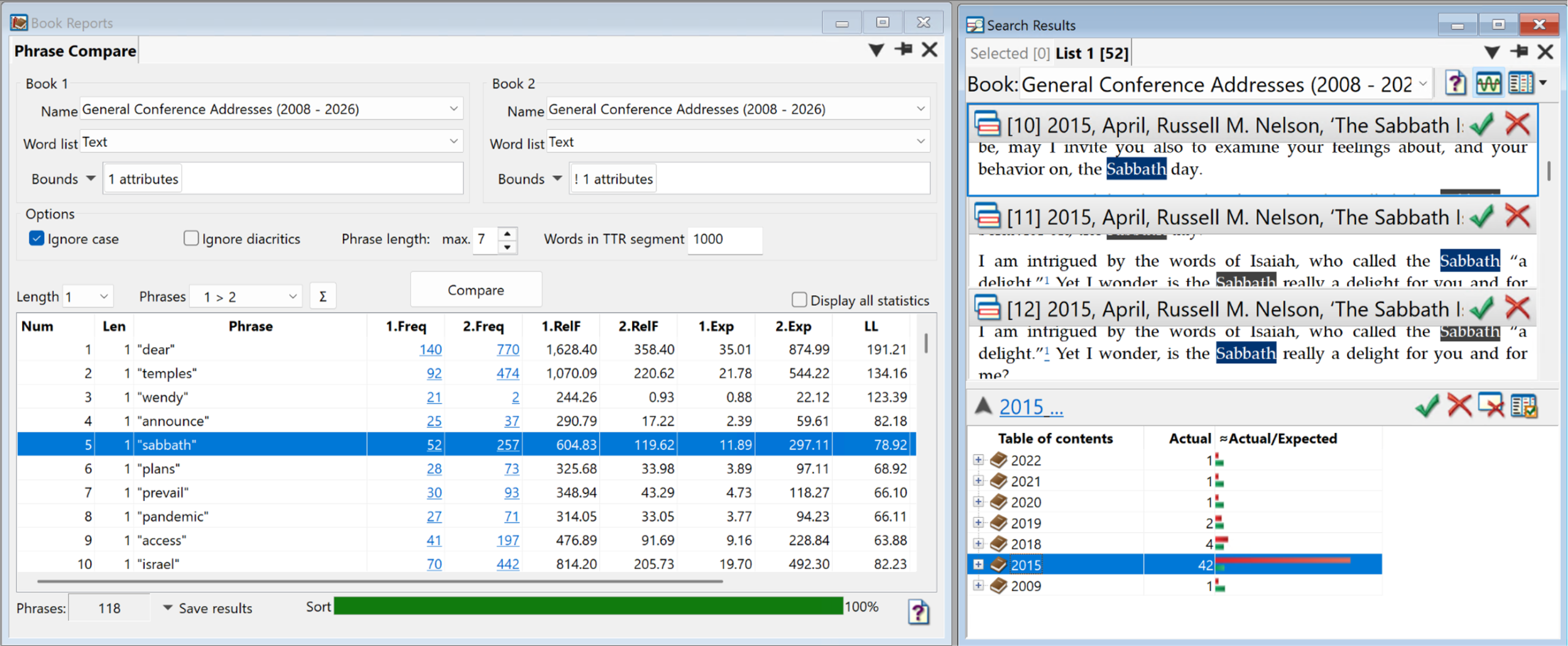
Figure 6. Search results for sabbath when said by Russell M. Nelson between 2008 and 2025.
Fifty-two times is a lot to talk about the Sabbath! But if we look more closely at the Frequency Distribution report, you can see that 42 of the times he mentions the Sabbath actually occurs in 2015. So while President Nelson mentioned the Sabbath more than most speakers did, most of the occurrences were actually from a single talk: “The Sabbath is a Delight.”
This is why dispersion matters: using a word 42 times in one talk may show that the Sabbath was on his mind during one Conference, but it doesn’t necessarily indicate that this was a recurring or major theme. President Nelson did mention the Sabbath regularly (at least once a year between 2018-2022), but he may not use the word as often as we initially may have thought.
Access
President Nelson used the word access 41 times between 2008 and 2025. When we double-click on the frequency (41), the search results will tell us two things: 1) whether this is an evenly dispersed word (used regularly across many talks) and 2) the context it is used in.
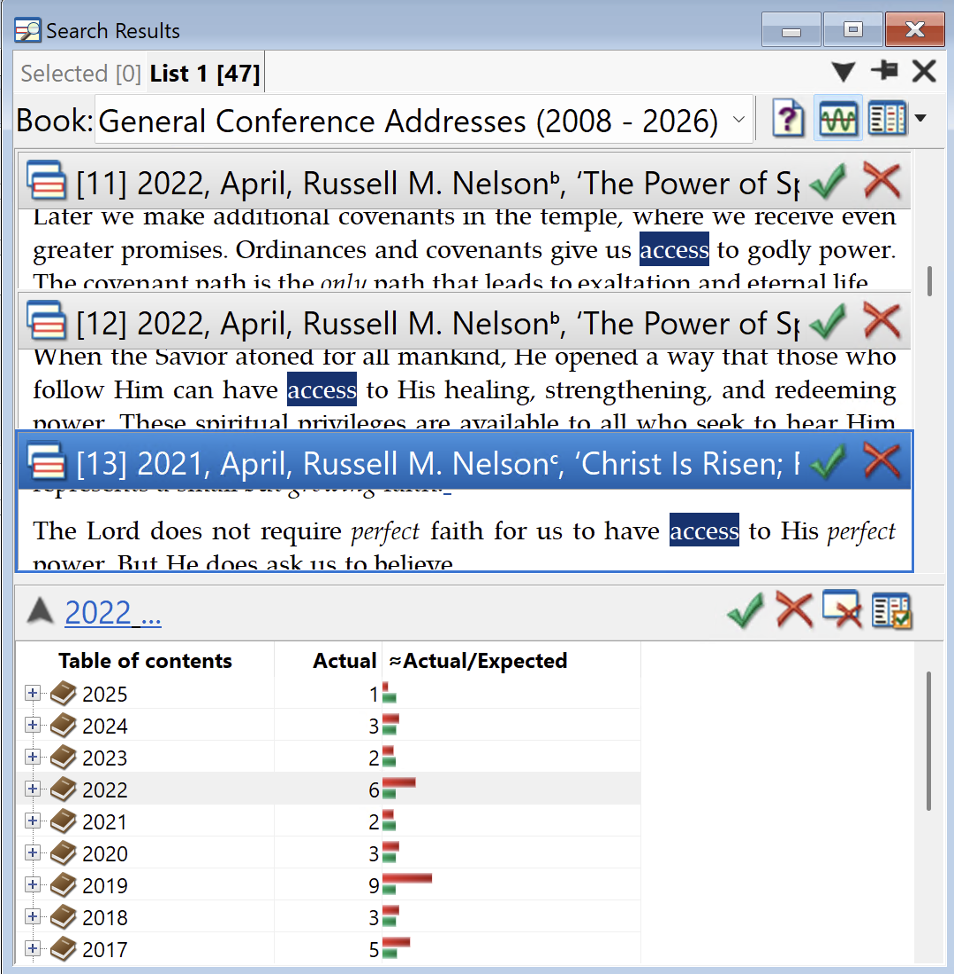
Figure 7. Search results for access when said by Russell M. Nelson.
President Nelson regularly talked about access throughout his time as a general authority–it’s not just a word that occurs in a single talk. Access to what, exactly? This is where the search results come in handy. Table 1 shows a few example results.
| disciples of Jesus Christ have | access | to a different kind of confidence |
| we gain greater | access | to the Lord’s strengthening power |
| increased | access | to the power of Jesus Christ |
| Ordinances and covenants give us | access | to godly power. |
| Even this year, when | access | to our temples has been seriously limited, |
| your endowment has given you constant | access | to God’s power |
| so that more families can have | access | to that greatest of all blessings, that of eternal life |
| increased faith and | access | to greater spiritual power |
Table 1. Key words in context (KWIC). Excerpts from WordCruncher search results for access when said by Russell M. Nelson.
Conclusion
President Nelson’s repeated focus on access seems to convey the relationship between us and the blessings we could receive: God’s power, eternal life, the atonement of Jesus Christ. He invites us to make that connection. You and I can access this power ourselves through covenants. It’s there waiting for us. The only question is–will we choose to access it?
Learn More
If you’re interested in learning more about WordCruncher, go to https://wordcruncher.com to download WordCruncher for free and learn how to use the software with our user guide. If you have any questions, please contact us at wordcruncher@byu.edu.